Scope of this review: I was approved for Veho and reviewed offers in my own account, but I did not accept or complete a Veho route. This article evaluates what the app displayed to me—not the on-route experience.
I applied to drive with Veho and was initially placed on a waitlist. Later, Veho notified me that I was off the waitlist and approved for the San Francisco market. That gave me something more useful than speculation: access to the actual offer board in my own approved Veho Driver account.
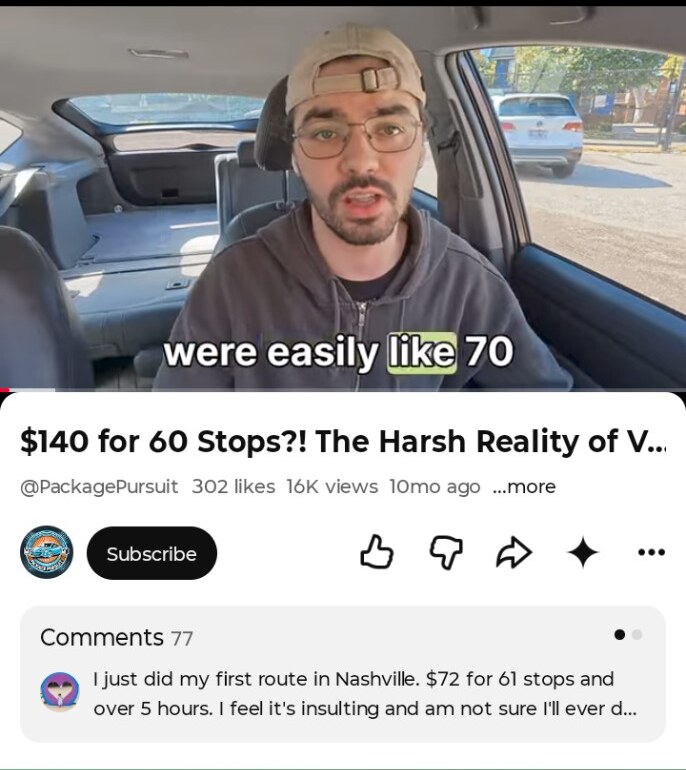
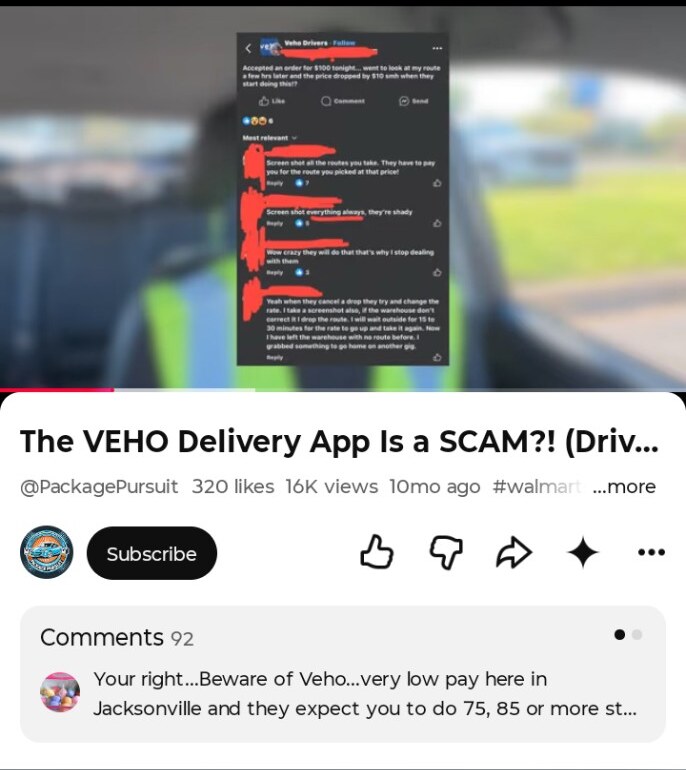
Before I accepted a route, I came across several experienced gig-delivery creators on YouTube discussing their Veho experiences. Some described high stop or package counts relative to the compensation. One creator even used the word “scam” in a video title. Those were their characterizations—not facts I was prepared to repeat as EqualMile’s conclusion.
Other drivers raised concerns. I checked for myself.
I did not simply take the videos at face value. Online commentary can be useful, but markets, routes, timing, vehicles, and driver expectations differ. Because I had already been approved, I opened my own account and examined what Veho was offering me in the San Francisco Bay Area.
The offer board itself gave me enough information to make a business decision. I did not need to spend hours, fuel, and vehicle life completing a route merely to prove that I did not like the offers available to me.
A driver doesn’t need twenty delivery apps. A driver needs profitable work.
The Veho offers displayed in my Bay Area account
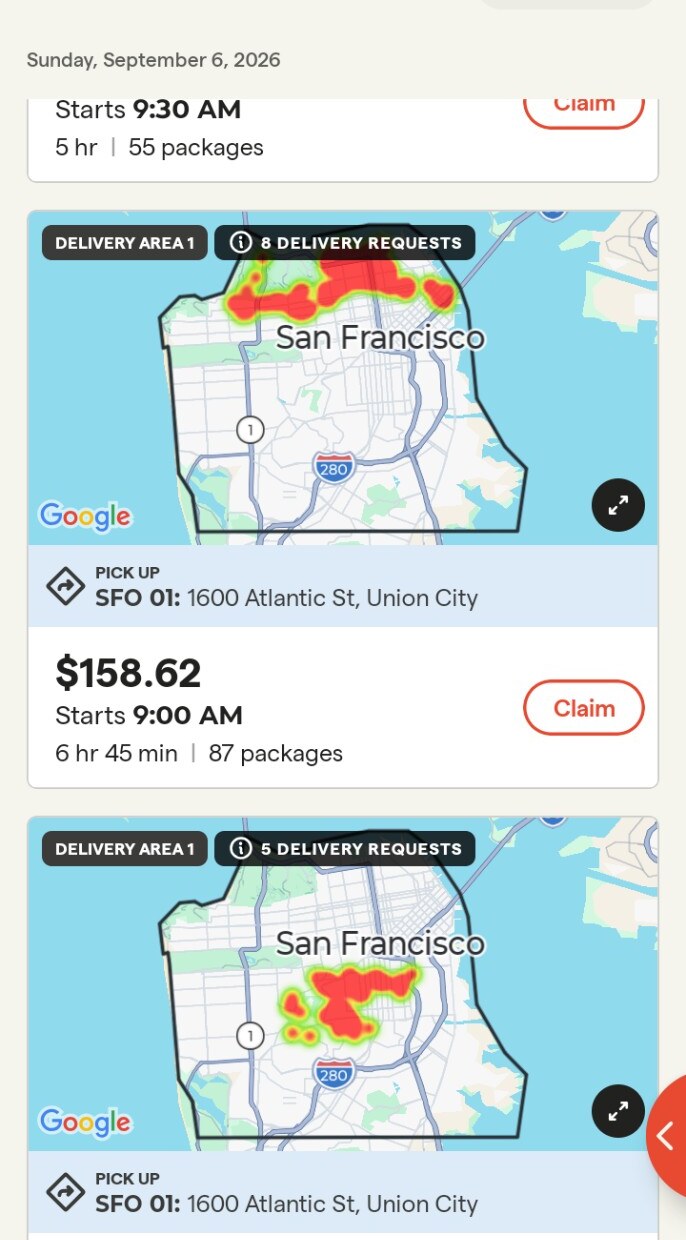
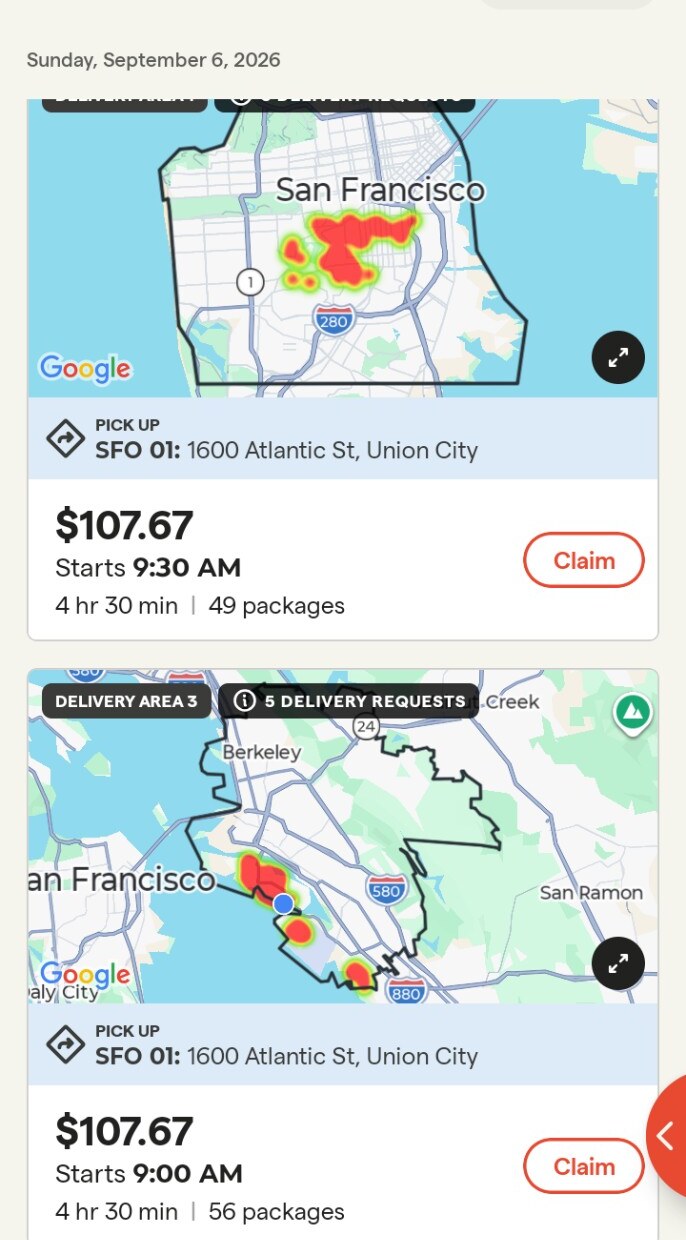
The routes I saw originated at SFO 01, 1600 Atlantic Street in Union City, California. The maps showed delivery areas in San Francisco and elsewhere around the Bay Area. These are the compensation, estimated duration, and package counts displayed by the app when I reviewed it:
| Offer | Advertised time | Packages | Gross per advertised hour |
|---|---|---|---|
| $158.62 | 6 hr 45 min | 87 | $23.50 |
| $118.57 | 5 hr | 55 | $23.71 |
| $118.57 | 5 hr | 50–53 | $23.71 |
| $107.67 | 4 hr 30 min | 49 | $23.93 |
| $107.67 | 4 hr 30 min | 56 | $23.93 |
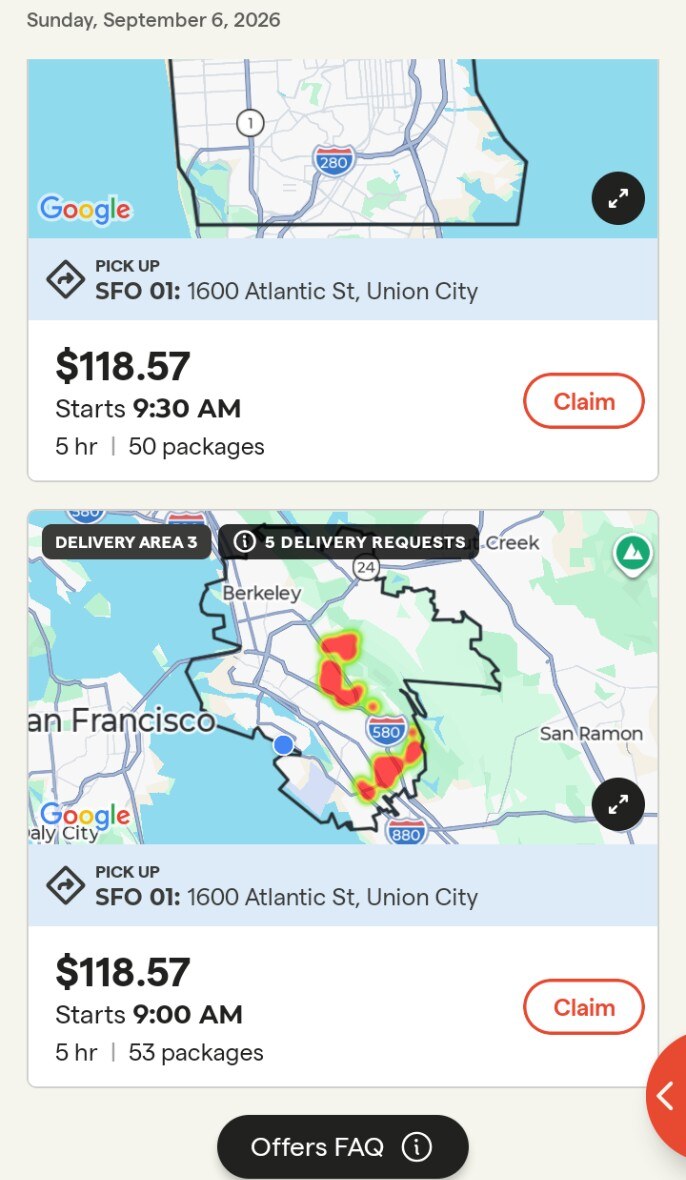
Gross advertised pay is not net driver income
On the app’s advertised time alone, the three compensation levels worked out to approximately $23.50, $23.71, and $23.93 gross per hour. Those calculations are simple division: $158.62 divided by 6.75 hours, $118.57 divided by 5 hours, and $107.67 divided by 4.5 hours.
Gross is the important word. An independent contractor operates a small delivery business. The number displayed in an app is not the same as money kept after operating costs, and advertised route time is not necessarily the contractor’s total business time.
- Fuel, maintenance, depreciation, tires, and commercial or personal insurance costs
- Time and mileage positioning from home or another market to the Union City warehouse
- Possible bridge tolls and other travel costs
- Loading, warehouse waiting, route setup, and package organization
- Actual traffic, parking, building access, and route conditions
- Time and mileage after the final delivery to return home or reach the next work area
- Opportunity cost—the other paid work a driver gives up while committed to the route
I am not claiming that any of these routes would have taken longer than Veho estimated, because I did not complete one. I am saying the advertised gross hourly figure did not answer the full business question for me. The package counts, warehouse positioning, destination areas, operating costs, and time commitment all mattered before I pressed “Claim.”
The location-permission question
During setup, Veho asked me to allow the app to access my device’s location while it was in the background. Its screen said location must be set to “Always” for proof of delivery and insurance, and it also stated: “Tracking is only active during routes.” Android then presented the permission as “Allow all the time,” with precise location enabled.
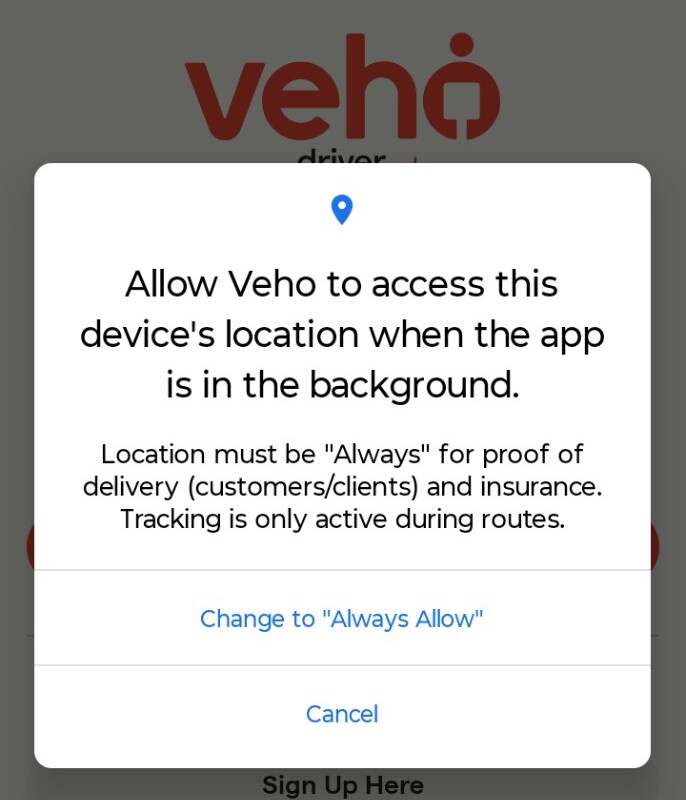
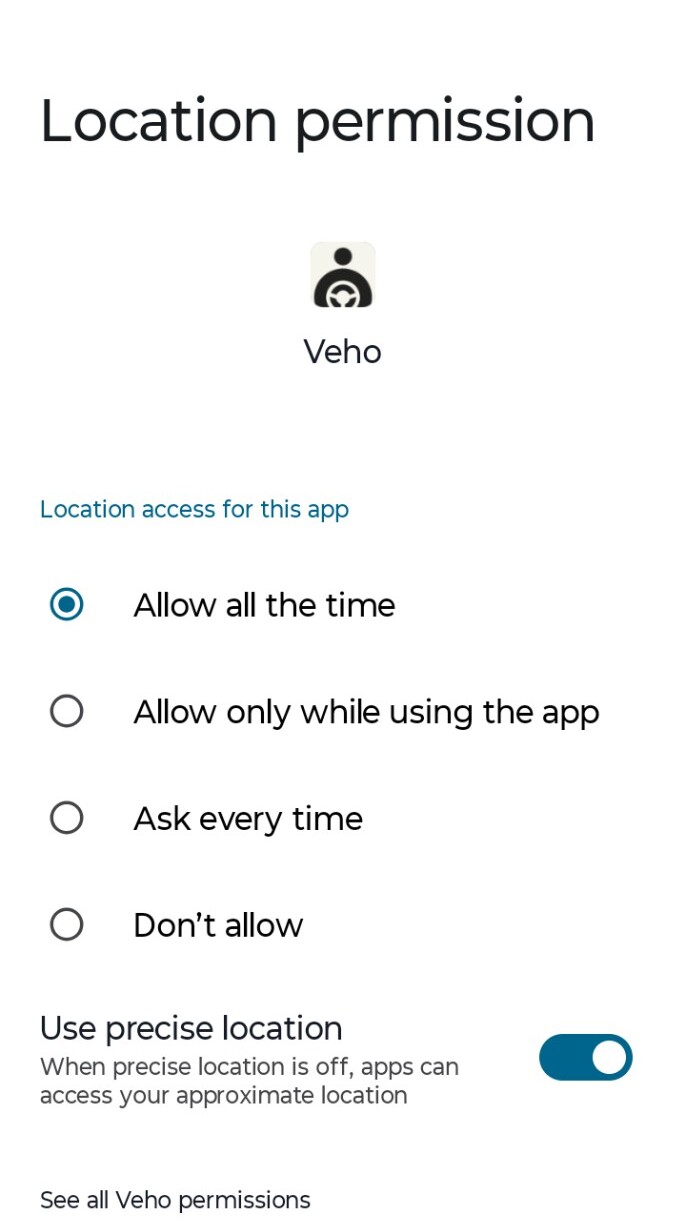
I am not claiming that Veho tracks drivers 24 hours a day. Veho explicitly says tracking is only active during routes. The legitimate question is narrower: if tracking is only active during routes, why must an independent contractor grant Android’s “Allow all the time” location permission? There may be a technical or insurance-related explanation, but drivers should understand what access an app requests and decide whether that permission is appropriate for an app they intend to use.
Why I uninstalled Veho without taking a route
After reviewing the offers available in my own account, the package counts, advertised time commitments, Union City pickup location, gross economics, likely operating considerations, and location-permission requirement, I decided Veho was not worth adding to my delivery operation. I uninstalled the app without completing a route.
That is not a declaration that every Veho route is bad, every market is identical, or every driver should make the same choice. Offers can change. Markets can differ. A driver with a different starting location, vehicle, cost structure, schedule, or business goal may evaluate the same board differently.
This is my personal business decision based on the offers displayed to me in the San Francisco Bay Area market on the day I reviewed them. Independent-contractor status includes the ability to assess an offer before accepting it. I did not need to buy a six-hour lesson when the information on the screen already answered my question.
Sometimes the most profitable delivery is the one you don’t take.
What this teaches us about last-mile delivery
The lesson is larger than one app. Route economics depend on more than a headline payout. Package density, pickup location, service area, access conditions, vehicle capacity, return mileage, and the contractor’s next-best use of time all shape whether a route makes sense.
That operational discipline also informs how I am building EqualMile. A sustainable local delivery relationship should respect the real work behind the route: positioning, handling, communication, access, proof of delivery, and the right vehicle for the job. Reliable service and fair pricing have to work for the customer and for the person doing the delivery.
The larger logistics lessons
- Evaluate route economics before committing—not after costs are already incurred.
- Compare gross advertised pay with the full operating day, vehicle costs, and opportunity cost.
- Package count, warehouse position, delivery density, parking, and final-stop location all affect the business decision.
- Read app-permission requests carefully and distinguish operating-system access from a company’s stated tracking policy.
- A firsthand review can be valid even when the conclusion is to decline the work—as long as its limits are stated clearly.