Scope of this review: I reviewed MealsNow offers through the VROMO Driver app but completed no assignments. I uninstalled the app without deactivating my MealsNow account. This article evaluates my firsthand offer-screen and notification experience—not completed-route performance.
I did not deactivate my MealsNow driver account. I uninstalled the VROMO Driver app from my phone. That distinction matters: the account still exists as a possible backup, but I am not actively using it because none of the assignments I reviewed justified the attention the app demanded.
The most irritating problem was the notification sound. It was loud, frequent, and disruptive. I could not find a practical way to lower or control it without affecting how I used my phone for the delivery platforms that were actually producing income. Throughout the week, the app repeatedly pulled my attention away from other work so I could open it, inspect another offer, evaluate the pickup, and decide whether it made sense.
An app does not create value merely by making noise. It has to deliver opportunities worth interrupting a driver’s day.
MealsNow was the opportunity. VROMO was the operating app.
MealsNow used VROMO Driver to present and manage delivery assignments. That relationship can be confusing when a driver needs help: VROMO provides the software, while MealsNow controls the delivery opportunity. During onboarding, I encountered a GigSafe payment step and contacted support. VROMO’s response explained that delivery-company issues had to be handled through the delivery company rather than the software provider.
That separation was not the reason I ultimately removed the app, but it added friction. My decision came down to something simpler: the offers available to me did not justify the money, positioning, or constant interruption.
What the VROMO offer screen showed me
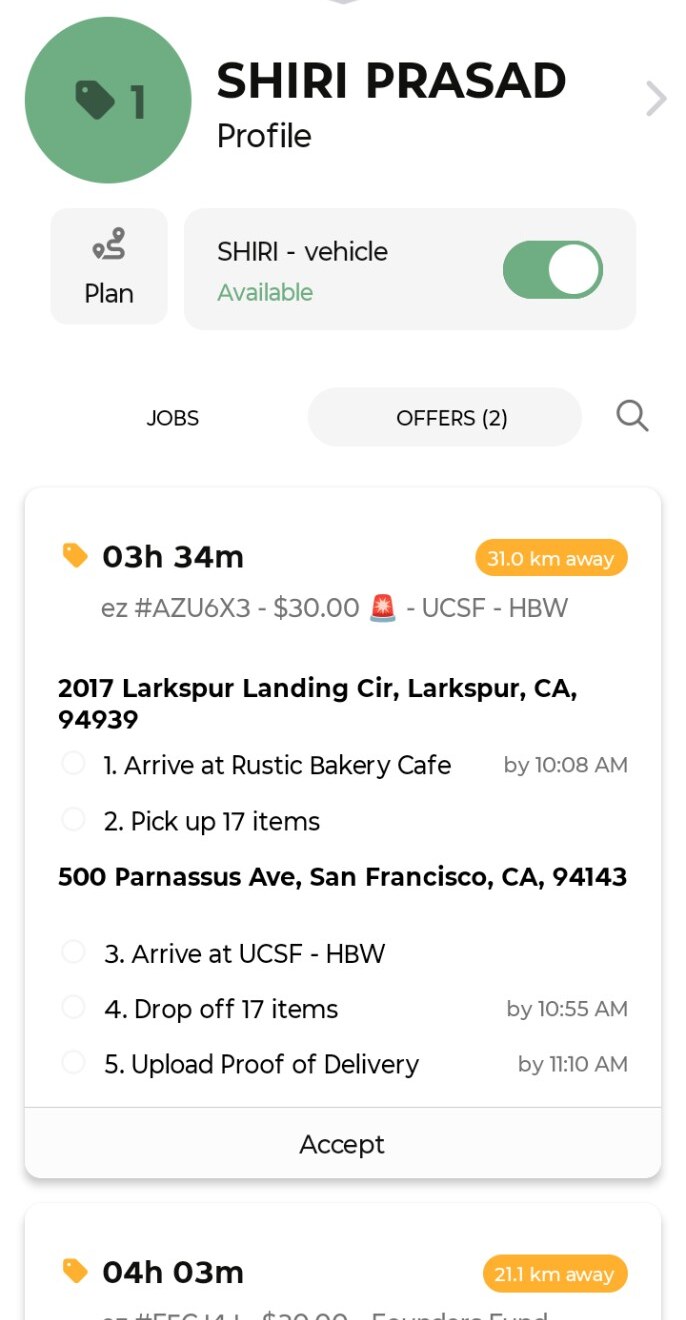
The screenshots below show two MealsNow catering offers displayed in my account. Each paid $30. One required pickup at Rustic Bakery Cafe in Larkspur and delivery of 17 items to UCSF on Parnassus Avenue in San Francisco. The app showed the pickup as 31.0 kilometers away—about 19.3 miles—from my position.
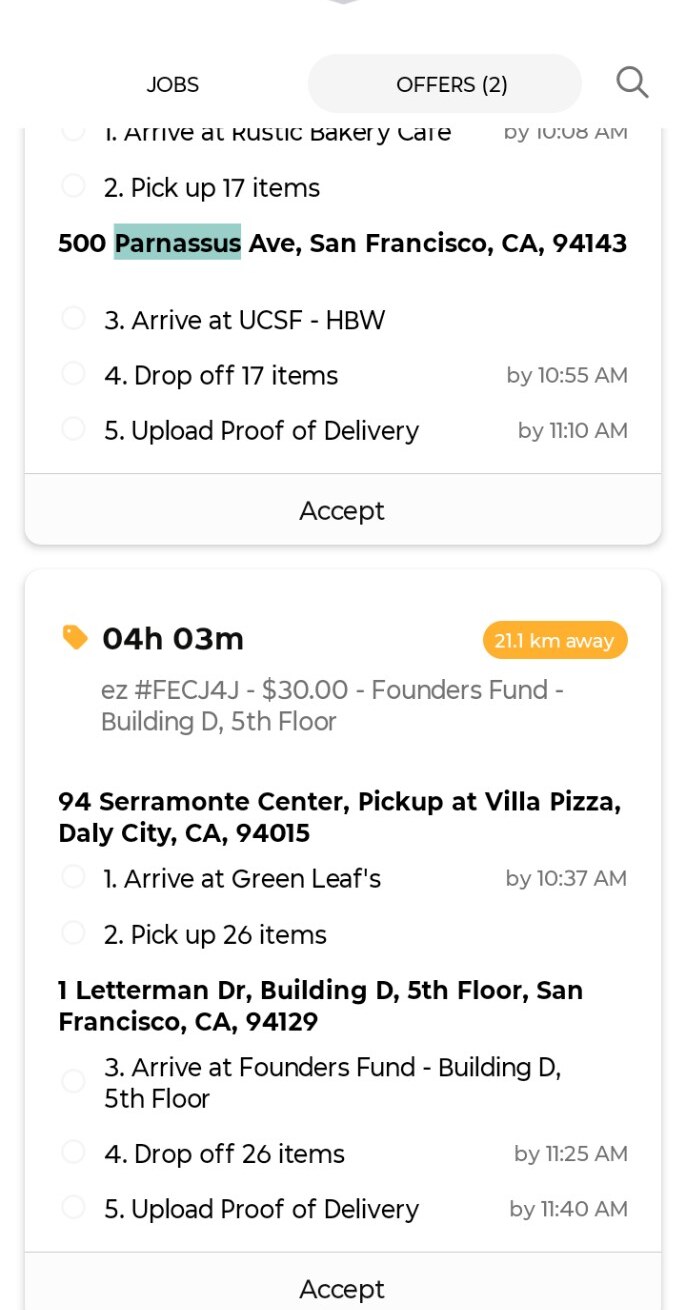
The second $30 offer required pickup of 26 items at Villa Pizza in Daly City and delivery to Founders Fund at One Letterman Drive in San Francisco. The app showed that pickup as 21.1 kilometers away—about 13.1 miles—from my position.
| Pay | Pickup distance shown | Items | Pickup and delivery |
|---|---|---|---|
| $30 | 31.0 km / about 19.3 mi | 17 | Larkspur to UCSF |
| $30 | 21.1 km / about 13.1 mi | 26 | Daly City to San Francisco |
The figures marked 03h 34m and 04h 03m appear to be countdowns until the scheduled work, not estimates of how long each delivery would take. I am not presenting them as route durations. I also did not accept either assignment, so I cannot claim how long the deliveries actually took.
A $30 payout is not a $30 profit
The pickup distance shown in the app was only the beginning. A driver still had to travel from the pickup to the customer, handle 17 or 26 items, navigate Bay Area traffic and parking, complete proof of delivery, and then reposition after the final stop. Without complete route mileage and verified completion time, I cannot calculate an honest net hourly rate. But I did not need perfect information to determine that these particular offers were unattractive to me.
- Unpaid time and mileage reaching a distant pickup
- Fuel, maintenance, tires, depreciation, and insurance
- Loading and handling a catering-size order
- Traffic, parking, elevators, building access, and customer handoff
- Return or repositioning mileage after delivery
- The income lost by committing to this offer instead of better work
Independent contractors are allowed to reject work that does not fit their economics. I did not complete a MealsNow delivery because I never saw an offer that gave me a sound business reason to accept it. Taking an unprofitable assignment merely to say I tested it would not have made the analysis more disciplined; it would only have made the lesson more expensive.
The hidden cost was attention
Every delivery app competes for space on a driver’s phone, but more importantly, it competes for attention. A notification interrupts navigation, customer communication, offer evaluation, or personal time. The driver has to look at the screen, understand the offer, compare it with current work, and either accept or dismiss it.
That interruption can be worthwhile when an app regularly produces profitable opportunities. In my MealsNow test, it was not. The alerts were especially loud, the offers were not compelling, and the app consumed attention throughout the week without producing a single assignment worth taking.
A backup app should create optionality—not operate like an alarm system for work you would never accept.
Why I uninstalled VROMO without deactivating MealsNow
Uninstalling the app solved the immediate problem: it stopped the disruptive alerts and removed a recurring distraction. I did not formally deactivate my MealsNow account because circumstances can change. Compensation may improve, service areas may shift, or a future assignment could become worthwhile. Keeping the account costs me very little when the app is not installed.
But a backup account is not the same as an active income source. Today, I do not count MealsNow as part of my working delivery operation. I completed zero assignments, paid close attention to what the platform displayed, and concluded that the available economics did not deserve continued access to my attention.
What this teaches us about last-mile operations
Drivers do not need the greatest number of apps. They need a focused portfolio of platforms and direct customers that produce workable revenue. Removing a low-value source of interruptions can improve decision quality on the opportunities that actually matter.
This lesson also applies to EqualMile. A delivery company should not expect a driver to absorb unlimited positioning, handling, and waiting costs behind a headline payout. Good last-mile pricing recognizes the complete job, and good dispatch communication respects the driver’s time before the route even begins.
The larger logistics lessons
- Driver attention is a limited operating resource, not free inventory for every app notification.
- Pickup distance must be evaluated before route mileage, handling, and return travel are added.
- A platform can remain a backup without earning a place in the driver’s active daily workflow.
- Declining every displayed offer is a legitimate test result when none meets the contractor’s economics.
- Delivery pricing and dispatch systems should respect both the complete route and the operator’s attention.